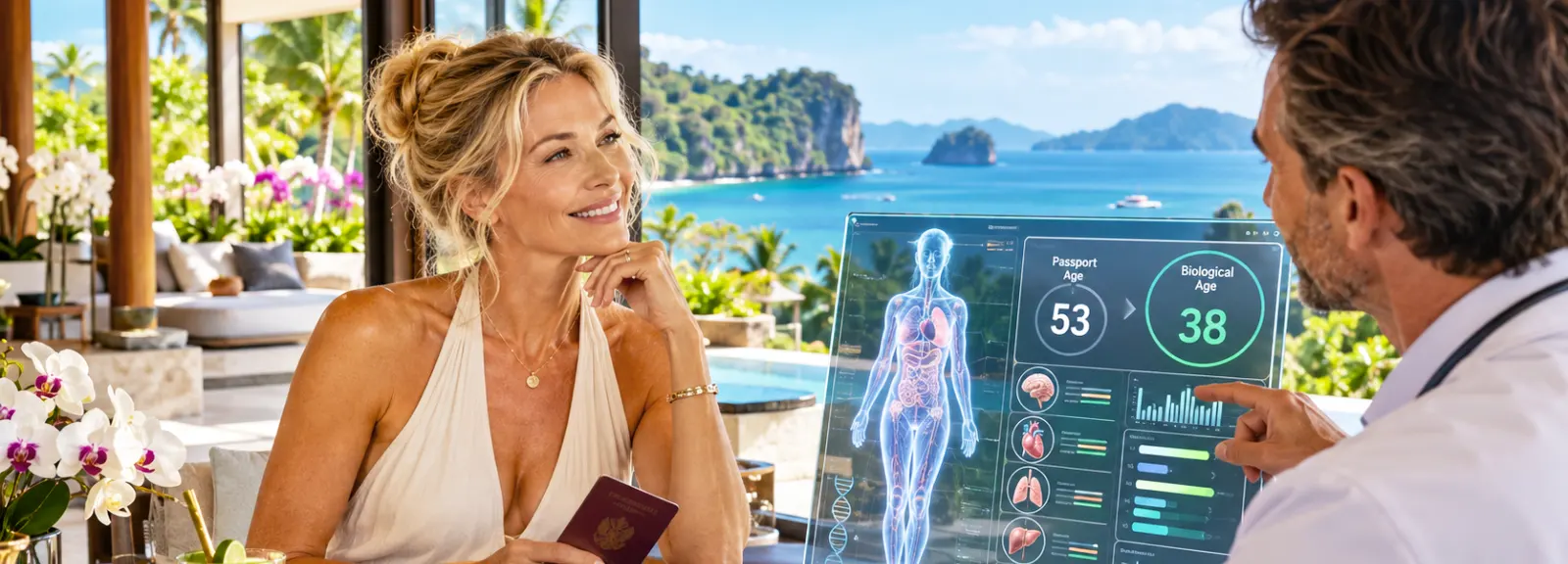
Your passport says you are 50. But is your body really 50 years old?
At this age, one person’s heart may still function exceptionally well, their blood vessels may remain flexible, their muscles strong, and their metabolism stable. Another person of exactly the same age may already have high blood pressure, impaired glucose metabolism, loss of muscle mass, chronic sleep deprivation, and reduced physical endurance.
According to the calendar, these people are the same age. Physiologically, they may be very different. This difference lies at the heart of one of the most fascinating areas of modern longevity medicine: biological age assessment.
In a previous Wellness-Phuket.pro article, we explored how Phuket is gradually evolving from a traditional resort destination into a center for preventive medicine and healthy longevity. The next logical question is: if we want to stay healthy longer, can we actually measure how quickly our bodies are aging?
Modern science says: to some extent, yes. But the answer is far more interesting than a single number on a test report.
What Is Biological Age?
Chronological age simply tells us how many years have passed since we were born. Biological age attempts to describe something different: the condition of the body in relation to typical age-related changes. If the health markers of a 50-year-old person resemble those more commonly seen in healthy younger adults, some models may estimate that person’s biological age as lower than their chronological age.
The opposite can also happen. However, one common misconception should be addressed immediately. If a test estimates your biological age at 44 while your chronological age is 50, it does not mean that you have literally “become six years younger.” Biological age is a calculated indicator. Different methods measure different biological processes, which means that the same person may receive different biological age estimates depending on the system being used.
In a major review published in Nature Medicine in July 2026, researchers Tony Wyss-Coray and Eric Topol described modern biological clocks as promising tools for evaluating aging at the level of individual cells, tissues, organs, and the entire body. These methods could potentially help identify elevated disease risk earlier and assess how the body responds to different interventions. At the same time, the authors emphasized that this field is still developing rapidly.
Why Do People of the Same Age Grow Older Differently?
Aging is not a timer that runs at exactly the same speed for everyone. It is influenced by genetics, physical activity, nutrition, sleep, smoking, alcohol consumption, body weight, psychological stress, previous illnesses, and many environmental factors. Even the ability to preserve muscle mass matters.
This is why differences between people of the same age can become especially noticeable after age 40 or 50. One person may exercise regularly, perform strength training, sleep well, and keep their blood pressure under control. Another may live a largely sedentary lifestyle, sleep poorly, and gradually accumulate visceral fat. They have lived the same number of years, but the condition of their bodies may be very different. This explains why longevity medicine is increasingly interested in indicators that reveal more than a birth date.
How Is Biological Age Measured?
There is currently no single universal test that can be considered the definitive measure of biological age. Instead, researchers use several different “windows” through which they observe the aging process. The most familiar level involves conventional medical indicators. Blood pressure, glucose levels, lipid metabolism, inflammatory markers, kidney and liver function, body composition, muscle mass, and physical performance can already provide a substantial amount of information.
Modern mathematical models can combine several of these parameters and compare them with data from large populations. The main advantage of this approach is its practical value. If an assessment identifies high blood pressure, impaired glucose metabolism, or insufficient muscle mass, the physician receives more than an abstract age score. They identify a specific health issue that can potentially be addressed.
Epigenetic Age: What Happens Above Our Genes?
One of the best-known approaches involves epigenetic clocks. Human DNA contains our genetic information, but gene activity is regulated by many additional mechanisms. One of these mechanisms is DNA methylation. These are chemical markers whose patterns change as we age. By analyzing those changes, researchers have developed mathematical models capable of estimating a person’s age with considerable accuracy.
Later generations of these systems began attempting to measure not simply the number of years a person had lived, but characteristics associated with biological aging and age-related disease risk. These assessments are commonly referred to as epigenetic age tests. However, caution is essential. A reduction in a particular epigenetic age score after changes in diet, exercise, or a medical intervention does not automatically prove that the entire body has been rejuvenated.
A marker may have changed, but whether that change translates into lower disease risk or a longer period of healthy life requires separate evidence. For this reason, responsible medicine should not turn epigenetic age into a promise of “turning back the clock.”
Blood Proteins May Reveal Which Organs Are Aging Faster
One of the fastest-growing areas of research involves proteins found in the blood. Proteins participate in almost every process in the body, from immune defense and inflammation to metabolism and communication between cells. The concentrations of many proteins change with age. By examining large numbers of these molecules simultaneously and analyzing the data mathematically, researchers can identify characteristic patterns associated with aging.
In May 2026, Nature Aging published a major review of protein-based aging clocks. The authors highlighted their potential for studying biological aging, disease risk, and responses to different interventions. At the same time, no single standardized system has yet been established. But perhaps the most exciting possibility is not simply estimating the overall age of the body. Researchers are gradually learning how to estimate the biological age of individual organs.
Can Your Heart Be Older Than Your Brain?
Imagine a medical assessment of the future. Your chronological age is 48. But testing suggests that your cardiovascular system shows characteristics more commonly associated with older adults, while your brain or immune system appears to have a more favorable biological profile. Not long ago, this might have sounded like science fiction. Today, it is becoming a serious field of research.
In a study published in Nature Aging, scientists developed models of whole-body aging and the aging of ten individual organs using blood protein data from more than 43,000 participants in a major UK biomedical database. The results were later validated in groups from China and the United States. Accelerated aging of individual organs was associated with future disease risk and mortality. In 2026, Nature Aging also examined the transition from general biological age assessment toward organ-specific aging clocks. Researchers increasingly recognize that different organs within the same person may age at different rates. This changes the question itself.
In the future, people may ask their doctors not: “How old is my body?” but rather: “Which of my organs are aging faster, and why?”
From One Number to a Map of the Body
This is where an important shift is taking place in longevity diagnostics. Receiving a striking number such as “your biological age is 42” may be interesting, but its medical usefulness is limited by itself. It is far more valuable to understand the structure of individual risk: How healthy is the cardiovascular system? What is happening with metabolism? Is muscle mass being preserved? How is the brain functioning? Are there signs of unfavorable inflammatory activity? Is the body recovering properly after physical exertion? Modern research is increasingly moving toward the creation of a multidimensional map of aging.
In September 2026, Nature Medicine published research on biological clocks developed for different organs and different types of biological data. The study also found differences in aging patterns between men and women, further demonstrating the limitations of a single universal measure for everyone.
Even Sleep Leaves a Mark on Aging
Interestingly, biological clocks are increasingly being used not only to describe aging but also to study lifestyle. For example, a large 2026 study compared sleep duration with 23 different biological aging indicators derived from medical imaging, blood proteins, and metabolic products. This illustrates where modern longevity medicine is heading.
Aging is no longer viewed as an isolated process that occurs independently of the way we live. Sleep, physical activity, nutrition, metabolic health, and other daily factors are closely connected with how well the body preserves its function over time. For this reason, good diagnostics should do more than provide an estimated biological age. They should help answer a much more important question: What can actually be improved?
Biological Age Testing in Phuket
For Wellness-Phuket.pro, this subject is particularly relevant. Phuket is gradually becoming a destination where traditional wellness travel is combined with medical diagnostics and preventive healthcare.
For example, VitalLife Scientific Wellness Center Phuket officially includes biological age assessment among its services. The center also uses biomarker analysis, DNA testing, and ongoing health monitoring to create personalized programs ranging from one month to one year. Its more comprehensive programs consider several layers of biological information, including genetic characteristics, proteins, RNA, metabolic products, and the microbiome.
Another example is Layan Life by Anantara. Its seven-day program includes medical and nutrition consultations, three-dimensional body analysis, sleep assessment, and an epigenetic cellular health test.
As a result, a new model of wellness travel in Phuket is beginning to emerge:
diagnostics → understanding individual risks → personalized program → recovery → long-term health strategy.
This approach offers significantly more than a collection of spa treatments.
Can You Become Biologically Younger?
Modern science gives a very cautious answer. Some indicators of biological age can indeed change. But changing an aging clock and proving true human rejuvenation are very different things.
Even a 2026 study that used protein-based aging clocks to evaluate the results of a clinical trial demonstrated both the potential and the limitations of the method. At present, these clocks alone cannot always distinguish changes associated with a specific disease from changes in the broader processes of aging. For this reason, the goal of a sensible longevity program should not be to achieve the lowest possible number on a screen.
What matters much more are real health outcomes:
- preserving muscle strength;
- maintaining normal blood pressure;
- sleeping well;
- maintaining a healthy body weight;
- supporting stable metabolism;
- preserving memory and cognitive function;
- maintaining strong physical performance;
- preventing disease or managing it early.
If biological age indicators improve at the same time, that is certainly interesting. But the number should follow health — not the other way around.
Modern Medicine Is Asking a Different Question
Perhaps the greatest value of biological age diagnostics lies in how they change our understanding of aging itself. In the past, people saw only their date of birth. Today, medicine is gradually gaining the ability to observe many of the processes taking place inside the body. There is no single magical test that can tell you exactly how quickly you are aging. But combining conventional medical diagnostics, epigenetic markers, protein analysis, medical imaging, body composition assessment, sleep data, and physical performance testing is gradually creating a much more complete picture.
Instead of asking: “How can I stop aging?” a far more useful question emerges: “What is changing fastest in my body, and what can I do today to preserve my health?”