Longevity medicine typically aims to slow the accumulation of damage: controlling blood sugar, reducing inflammation, maintaining muscle, sleep, and mitochondrial function.
But researchers from Revel Pharmaceuticals, Calico Life Sciences, and the University of Colorado have proposed a different approach — not just preventing damage, but also attempting to repair accumulated changes that have already occurred.
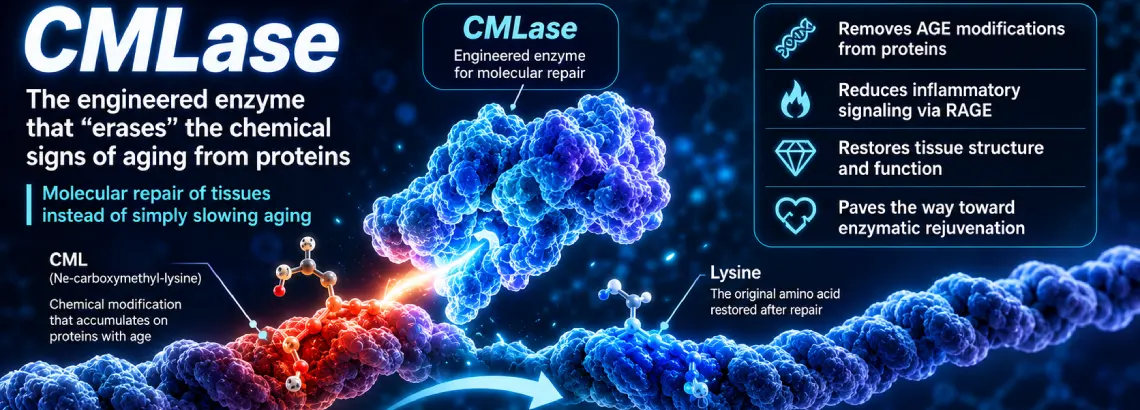
They have engineered an enzyme called CMLase, capable of removing one form of glycation from proteins — CML. These compounds form when sugars react with proteins, especially long-lived ones: collagen, proteins in blood vessels, skin, eyes, and connective tissue.
With age, such modifications may affect tissue elasticity and sustain inflammatory signals. In laboratory experiments, CMLase reduced CML levels in various proteins by 52–97%. In samples of human skin, aorta, and lens, a marked decrease in this marker was also observed.
Importantly, this does not mean the enzyme «rejuvenated» tissues by decades. It targeted only one type of chemical damage, while aging depends on a multitude of processes.
So far, CMLase has only been tested in the lab and on tissue samples. It remains unknown whether it can safely work inside the body, penetrate tissues, and improve their actual function. Moreover, being a bacterial-derived protein, it may trigger an immune response.
Nevertheless, the idea looks promising. In the future, scientists may create enzymes targeting different age-related protein damages. This is no longer just prevention — it is an attempt to move toward molecular repair of tissues.
For a wellness approach, the takeaway is simple: a healthy lifestyle still remains the foundation of longevity, and such developments show what the next stage could look like — personalized prevention and restoration at the molecular level.
This material is for informational purposes only.
You can read more about CMLase on Biohacking Strategy.